The End Of The World As We Know It

Occasionally, as you will know, faithful blog trotters mine, I get a little bit taken with a prime example of the admaker’s art, and all overcome with how brilliant they are at selling stuff. I know how sad this is, but, still, credit where credit is due – when I have been presumptuous enough to try and identify key trends in communication (any communication, nota bene), I have always put humour right up there at the top of the list. Make people laugh in an unexpected, wry, self-deprecating or genuinely funny way (and you’d be surprised, or maybe you wouldn’t, at how much humour isn’t, actually, genuinely funny – and is none the worse for it) and you’ve got ’em.

Everyone likes a laugh – better still, everyone likes a clever laugh – and never more so than when everyone’s hurting financially, as we all are currently. (As those who were elected to take care of the world instead f*ck it all up on our collective behalf. Thanks.)

Now, obviously, not all brands or companies can use the humour route. Oil exploration, energy generation, financial services (and related industries) and funeral directors – amongst others – face something of a challenge if they want to make funny, and my advice would be not to try. Thus and therefore it actually behoves those brands who can do it – mostly fast-moving consumer goods with personality (think beer and crisps and smoothies) – to get to it on the hurry up. Take, for example, the truly magical ‘Good Call’ Fosters adverts – if you’re not familiar, can I suggest you do a YouTubey on their ass – which never fail to make me feel better about life in general.

(However, and extraordinarily germane to this post, have a look at this link and breathe a collective ‘wtf’. )

So, the latest commercial execution to make me feel so much better about things in general, to restore my faith in humanity, is the latest Lynx ad, for its 2012 Final Edition deodorant. Yes, snorkellers, I am going to post a link to it, but before I do that, I need to make the odd incisive observation – as is my wont.

For those who don’t know, Lynx is a (sorry, Lynx guys) fairly downmarket range of male grooming products – shower gels and deodorants. But the brand has become iconic through its marketing communications – it’s clever, it’s tongue-in-cheek, it’s not too serious – hell, it’s sexist, but even the laydeez have a laugh (*). Personally, I’m a customer. Those who are familiar with the products and what they appear to promise will share my frustration at the fact that, to date, no angels, or bikini-clad women have actually invaded my personal shower space while I have been using said products, but I look at it like the lottery – gotta be in it to win it.

(*) How do I draw this conclusion? Read on, blog rollers, read on.

Anyway, long story etc etc. As you’ll all know, the world is going to end on December 21 2012. Or perhaps not – perhaps it’ll be more a sort of cataclysmic event, and not an end. Or possibly, it’ll be a sort of spiritual transformation and things will not only not end, they will positively continue, but perhaps in a different fashion.  (NB again – I have to say, all this strange stuff going on in the world currently – continent-sized icebergs in Antarctica, earthquakes in Japan and SF, flooding in Thailand, 29 degrees in the UK in October, social unrest globally, the Arab Spring and Greece about to cause the biggest period of economic instability since economics was invented by that nice Mr Milton Keynes – does make you wonder whether we’re not, in fact, lining up for a cataclysm. Just me?)

So the nice Lynx people make a fabulous leap of creativity, announce their Final Edition body spray and make an ad – well – watch it for yourself here. I like this a lot. It is clever. It looks good. It has a nice soundtrack and, best of all it completely embodies what I perceive the brand to be about. Tongue-in-cheek – we all know that no amount of body spray is going to render a bearded carpenter (hey – new connection! One I’d missed! It’s sacrilegious as well!) magnetically attractive to women – but, well, I’ll keep using the stuff. You know, just on the off-chance. Anyway. Enjoy.

Finally, and tying up all the loose ends. I’ve posted a link to a Lynx Facebook page deliberately. I’m drawing the conclusion that the laydeez are having a laugh as well, despite it being a tad sexist, because they don’t appear to be complaining.

I posted a link to the Pink News and its questioning around the homophobic nature of the Fosters Good Call ad as an illustration that no matter how clear you are about your intentions, no matter how obvious the comedy, not matter how clearly it is a case of ‘laughing with you, not at you’ – there’s always space to be filled, comments to be made and, yes, people who will take offence at anything.

And with social media, these joyless, humourless, literal and narrow-minded curmudgeons get their say. Check out the comments on the Lynx Facebook page. Here’s an example:

“This is a really sick fuckin ad, playin on peoples fear and vulnerability. take it off tv ads idiots…..”

There are those who champion the use of social media in a marketing context because it’s all about the conversation, the learnings from the consumer – well, you try having a conversation with, or learning from, that particular fucknut.
Facebook – Show Me The Money

Today, I present, for your delight and delectation, a piece from the Wall Street Journal, a regional newspaper with a reasonable circulation, entitled ‘Big Brands like Facebook But They Don’t Like To Pay’. I am not going to paraphrase or summarise the article so, lazy blog trotters, you’ll have to get all clickety wid it for yourselves.

So, to my mind, there a few key points to be dragged out of this, and you’ll forgive me for re-ordering them, but in the following sequence, they make more sense:

  • Facebook’s global revenues were ‘not as robust as I would have expected”, said eMarketer analyst Debra Aho Williamson.
  • Facebook’s estimated market value, now in the neighborhood of $70 billion, is founded on the belief that companies will spend big to advertise on the site. Facebook’s revenues, which come largely from ads, were $1.6bn in the first half of this year, up $800m from a year earlier.
  • Facebook is expected to capture just 6.4% of total online ad spending this year, according to estimates by eMarketer.
  • EMarketer expects Facebook’s ad revenues to reach $2bn in the US, from 162 million unique users, according to comScore; Google is expected to earn $12.8bn in US ad revenue from 184.6 million unique US users, according to comScore.
  • The auto maker (Ford)……….said it spent less that 5% of its total online ad budget for the (Ford Focus) campaign on Facebook.
  • Martin Sorrell………..said Facebook works for brand building, but companies that use traditional advertising “are invading a social space. You have to be extremely careful”.
  • “You can give them money, and they can give you Likes,” said Mr Kelly (Scott Kelly, Ford’s head of digital marketing), “but the question is, what is the value of those Likes?”
  • “Likeonomics.” Rohit Bhargrava, SVP with WPP agency, Ogilvy.
  • Facebook says 96% of the top 100 US advertisers, as ranked by Ad Age, bought ads on the site in the past year. Of the world’s 100 largest companies, 61% have a presence on the seven-year old company, up from 54% last year, according to Burson Marsteller.
  • Sony Corp is shifting 30% of its traditional ad budget into social sites, including Facebook, for its Playstation console. Diageo, maker of Smirnoff and Guinness, committed in September to spending more than $10m on Facebook ads.

So, snorkellers all, I’m just throwin’ this out there:

  • Facebook’s immense valuation is based on its certainty that companies will spend big on ads. They’re not. Most of the ‘Book’s ad revenue comes from SMEs.
  • Ford used Facebook for its ‘viral’ possibilities – it spent a little and then pulled the spend once momentum had been achieved. Ford’s head of digital raises questions over value.
  • Martin Sorrell issues a warning against traditional advertising on Facebook and even Diageo (one of ‘Facebook’s recent successes’) is only committing $10m to Facebook ads – which is hardly the big bucks Facebook needs.
  • 61 of the world’s top 100 companies have a ‘presence’ on Facebook – define ‘presence’, please

I’m still looking for the Emperor’s underwear here.

My perception is that Facebook is finding it tough going monetising its undoubtedy enormous user base – and this is partly because savvy companies (Ford amongst them) realise that – whetever value there may be in using Facebook as a marketing and sales tool – it is not delivered through advertising on the site.

Facebook themselves are not helping their cause as David Fischer, VP of advertising and global operations for Facebook, has said that the company is “building our business for the long-term” – and turning down ads that compromise the user experience. In addition, Facebook ads are small – because of an early decision by Zuckerberg to keep the site uncluttered.

Sorry Facebook – you can’t have it both ways. You can either liberate the revenues and sell companies what they’ll pay for – or you can stick with your ideals, and never realise the potential that might (just might) justify the frankly obscene estimated market value that’s being bandied about.

My bet is that Zuckerberg will attempt to have his cake and eat it – and the rumoured float next year will be a car crash of epic proportions.

Made-Up Jobs In Communications – Chief Content Officer

Once upon a time, there was a chap called Nicholas Graham, who (in 1985) started a company called Joe Boxer, which sold (and still sells) underwear. Nicholas Graham syled himself  ‘Chief Underpants Officer’. I have often wondered whether I should give myself a spurious title (rather than simply ‘Managing Director’ (of The Wordmonger Limited)) but, honestly, I’ve not been clever enough, to date, to come up with something that works.

And, let me tell you, Chief Content Officer is something that doesn’t work. I have difficulty with the concept of content anyway – it smacks of a term coined in desperation to describe a disparate and amorphous group of extraordinarily different concepts and products with the idea of somehow ‘bucketizing’ it (thank you, America), thereby rendering it somehow harmless, easy-to-understand and pigeonhole and – above all – non-threatening. The content conceit has developed in parallel with the proposition that we have never faced such corporate communication complexity and an entire industry has grown up around it, propagating fear and awe in equal measure and taking a large cut of the content investment it recommends.

So I’m not really a believer then.

Anyway, here you are, snorkellers, here’s a piece from Forbes, asking the question ‘Do organizations need a Chief Content Officer?’ and, as far as I can see, failing, abysmally, to answer it.

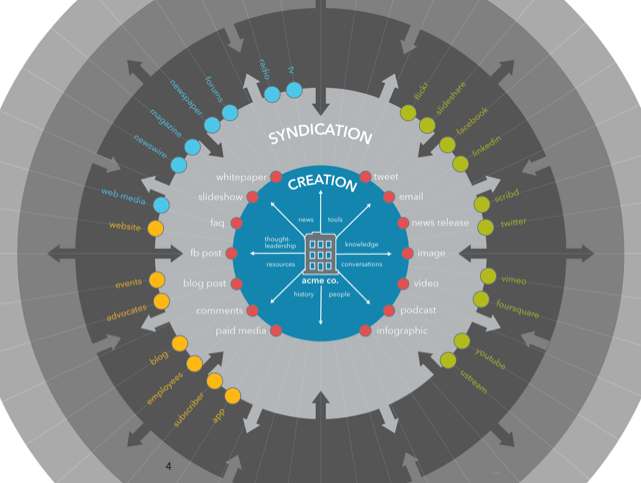
Apart from the fact that I started to get a headache when I read this – which is a sure sign that it’s more complex than it needs to be – it’s also got a diagram, reproduced below.

Which, frankly, gives me the heebeejeebies.  This is trying to put a forced order onto a naturally chaotic process. Trying to define what things are, identify where they come from and map out where they go. This is trying to create a science around what is essentially an art. This is all about complicating something intuitive with badly-drawn rules. I could go on.

Content? It’s the same old stuff that we communicators have been producing since time began, with a few new bits. Audiences? The same old audiences, with some new points of access. And the audiences vary from topic to topic, product to product, concept to concept – there is no hard and fast set of messages or basket of content that will suit every audience, every time (what you tell your investors will be different to what you tell the community in which you operate and different again to what you might tell your employees). This is not to say that there shouldn’t be a single central theme on which you hang the audience-driven elements – but still, trying to diagrammatize it (thank you again, America) is a pointless exercise in navel-gazing – thought and talk, for thought and talk’s sake.

Chief Content Officer? Librarian, right?

A Response From Orange, Mobile Network Provider of This Parish

So, Blog Snorkellers all, I got my mobile network problems sorted and am now up and running with email onna go. Amazing how quickly these things get sorted when you loop in the senior personnel of a company.

In fairness to Everything Everywhere – I sent an email to their CEO, CMO and Chief Performance Officer late on a Wednesday evening and by Thursday midday, everything had been rectified. I got an email from the CMO and a ‘phone call from the office of the CEO. It became the sort of experience that, as a loyal customer of ten years’ standing, I would have expected from the off. (Well, I don’t actually expect a ‘phone call from the CEO’s office, every time I renew my contract, but I do expect easy and quick.)

But I guess you can see where I’m going with this. Why does it take several hundred words of borderline crazy rantiness, delivered directly to the C-Suite, to get a result?

This is the digital age. This is the age where anyone can broadcast their thoughts and opinions far and wide, easily and instantaneously. As my faithful few followers will know, I’m not a fan of social media – but I do recognise that where it comes into its own is during a crisis, either as a response, or as a crisis creator.

Customer service is key. No matter how good your corporate reputation, no matter how loyal your customers, they can be turned against you almost immediately by one person’s bad experience. In days gone by, you could let it slip occasionally, safe in the knowledge that – as long as no-one died, and you didn’t annoy a journalist (or a journalist’s friend) – no-one would find out.

No more. The bigger you are, the more important it becomes that you get it right every time.

A learning, I think.

A Letter to Orange, Mobile Network Provider of This Parish

Here, dearest Blog Trotters mine, is a letter sent, via the medium of  ‘e’ mail, to the CEO, CMO and (oh but yes) the Chief Performance Officer of Everything Everywhere, the company formed through the alliance of Orange and T-Mobile. I’ll let you know whether I get a response.

(Still have no email on my B’Berry, by the way.) (I knew you’d be concerned.)

“Dear Olaf, Pippa and Ralf
Having been, finally, beaten by your impenetrable ‘customer service’ network (a completely new and totally unexpected definition of the term ‘customer service’ that I’d not encountered before), I am really, really hoping that you will be able to solve my Orange problem for me. (Congratulations on the company name, by the way – genuinely visionary and grandiose. If only it wasn’t the complete opposite of my experience to date.)
A long story short – as I’m sure you’ve all got better things to do (I know I have) – I’ve been a genuinely loyal customer of Orange for over 10 years and, to date, while it’s been (with hindsight) a bit pricey and I don’t like being sold insurance that I don’t need, I’ve been happy with it. Never even considered moving. Over the last four days, however, all of that has changed – rarely have I felt so powerless in the face of complete corporate ineptitude. Seriously, guys, whoever designed your call handling systems, the automated responses and the customer-facing website functionality should be tracked down and punished, in a cruel and unusual way. And so should the person who sold you the idea of outsourcing your call centres (I’m guessing that they are outsourced) – as the systems don’t work and even if they did, the call centre staff don’t have the knowledge to do anything with the account data the system is supposed to provide. I suspect it’s cost-cutting and lack of forward planning – but, whatever the cause, it’s frustrating and it will lose you business.
So – I’ve got an upgrade to a new Blackberry device. There was a slight delivery snafu, but it arrived. I’d been told to ring a number to activate the SIM. Did that on Sunday – the rather irritating call centre chap told me I should have done it online (incidentally, when I DID try to do it on line, the service didn’t work), but then said he’d be able to sort it out. Monday morning – not done, so I called again. Monday afternoon, nothing happening, called again, assured that a supervisor would be activating my SIM. Late Monday afternoon, call again, recorded message tells me that a problem precludes me being connected to an operator, and I should call back. Monday evening, nothing doing, call again, put on hold for 20 minutes, then cut off. (Meanwhile, and while I’m on a roll, why do I have to go through umpteen ‘if you want this, press that’ prompts, every time I ‘phone, when I still end up with the same lacklustre call centre staff, all of whom (without exception) have to contact someone else to address my query? And what, in the name of all that’s holy, is a ‘magic number’?)
Tuesday morning – hallelujah – SIM activated. Attempt to connect to my internet email accounts. Wah-wah and, indeed, oops. Either I’ve got a purely enterprise device, not allowing (as I’m sure you know) connection to internet mail accounts, or I’m being stupid. Let’s take the latter option – it’s been known. I visit your Orange website – again, do you know how difficult and painful it is to find things on that site? Couldn’t find anything helpful. Today I braved your call centres again, looking for a resolution to the problem – who knows (not me) maybe Orange can tweak the B’Berry enterprise software and provide me, remotely, with a consumer-facing device. Suffice it to say, your operative either couldn’t, or didn’t, address the issue. Nor did she call me back when she said she was going to.
So, here I am, with device, without email. Perhaps unfortunately, I tend to rely on email to keep me in touch with career and business opportunities, so I’m a little stifled right now. Two questions:
How has Orange come to this? It was brilliant – now it’s rubbish. Is this the Everything Everywhere influence?
Can you sort this out for me – or do I, and with regret, take my business elsewhere? I know I’m just one punter, but on the basis of my recent experience, I won’t be the last.
Perhaps a little less spend on marketing and a little more on nuts and bolts and getting the experience right.
All the best
The Wordmonger
PS And, lest I be accused of not making enough effort (sigh), yes, I have emailed Orange, via the same difficult website, twice, once asking advice and once complaining. No response to date. I know it says ‘a response within 48 hours’ – but, really, 48 hours? In today’s social media-driven world? Time for reflection, I think.
PPS I know I wrote, earlier, ‘long story short’ – but, well, hey……….”

So Terribly Wrong

Not, not me. Although it appears that I HAVE actually been wrong – there was I, giving it large with the old ‘that Facebook, right, doesn’t make any money, right’ while all the time the odious Zuckerberg is busy turning in halftime revenues of $1.6bn and incomes of 500m of the same splendid currency over the same period. Numbers such as these, ladies and gents, while not actually being handed in by someone from the ‘Book itself, are not really to be sniffed at. Read about it here at The Huffington Post. Thank you, Huffers.

No, no. What’s wrong (on a veritable Dante of levels) is how Horrible Mark and his evil creation have managed to achieve these numbers – it’s through getting so many users that they cannot fail to get at least some of the large global advertisers (Diageo – are you listening?) to spend at least some of their enormous advertising budgets with the Facemeister. Proving, once and for all, that you can fool some of the people, some of the time and they’re the ones you should concentrate on.

But then. Look at the numbers, would you – here they are! (Thanks MediaBistro!)

Yes, that’s right – 800m users. Just think about it. What’s the population of the world – what, around 7bn? Thus – and I know you can do maths – more than 10% of the population of the Earth are registered users of Facebook. Given the great swathes of the world that haven’t got internet access, that means that practically everyone you know (except me) is a slave to the ‘Book. How long before someone coins the phrase ‘the Good ‘Book’?

So, you’ve a heady mixture of 800m users and quite possibly 1bn greenbacks of income for this financial year. You’ve also got, therefore, a valuation of as much as $80bn for the ‘Book when it floats – supposedly in 2012.

Those of you with memories will remember Goldman Sachs, busy doing God’s Work (thanks Mr Blankfein), and the bank that took a position in Facebook and started up a Facebook investment vehicle (that their very own private equity arm would not invest in  and that they were only allowed to sell outside the States – where’s Britney Spears when you need a burst of Toxic pop?).

The same Goldman Sachs you’d hope would be handling the flotation of Facebook. The same Goldman Sachs whose shares have fallen 43% this year. Have they been Zucked?

Reinventing Online Shopping With ‘Social Commerce’

Thanks to The Globe and Mail (Toronto) for this article published yesterday, entitled ‘Retail Giant’s @Walmartlabs plans to reinvent shopping with ‘social commerce’.  You can read it by doing the light clicktastic on this word here.

Working in retail in 2000, as I did, one of the questions that ‘brick-and-mortar’ retailers were often asked was ‘do you feel threatened by the rise of e-commerce?’ To which the answer was ‘no – people will always want to experience real goods, in real time, in real surroundings, sold by real people.’ At the time they were right, the tech bubble imploded and things (briefly) went back to how they were.

But, d’you see, we got it wrong – both the question and the answer. We got the question wrong because we didn’t know what to ask – social media had not been invented – and we got the answer wrong because we could never have imagined how reliant people would become on the opinions, statuses, needs, wants and ill-informed dogmatism of others.

The question now is – as a ‘brick-and-mortar’, offline retailer, do you feel threatened by social media?’ And the answer really should be ‘yes’. When Walmart are bringing social media to the in-store shopping experience (want a review of the microwave you’re looking at? Post a message – a member of staff or another customer will respond to you. Want to know where the peanut butter is? Post a message – someone will respond) then you can be certain that this – or something like it – is the future.

And as for the boy turd Zuckerberg – yes, of course he’s in on it. To quote the article – ‘this is where Shopycat comes in. The Facebook application uses social media profiles and comments to generate gift ideas’. Back to Walmart’s breathless tech spokesperson, Venky Harinarayan. (No disprespect to Venky, he (or she, I suppose) has already made a sizeable fortune selling Walmart a thing called Junglee, a shopping comparison site. Well done, that capitalist.)

“It is becoming clear to us that one of the shopping behaviors that people have that is inherently social is gifting. We are building a product that we believe makes peoples’ gifting much more efficient, because all of your friends and family, within reason, are on Facebook. We are leveraging that information to help you buy better gifts and make it easier for you. We believe gifting and social networks are fundamentally made for each other, so getting that right over the next year will be important to us.”

D’you know, snorkellers mine, I’m going to leave it there. I’ll let you work out the number of different levels on which this is just so wrong.  I’ll start you off.

‘Efficient gifting.’

Baileys on Face

Ah, snorkellers mine. D’you know what day it is? It is Sad Day.

You know that ( to my mind) rather charming and evocative painting by the clearly quite stable Mr Munch – The Scream? That, dear trotters all, is a bit like how I feel today, on Sad Day, only the painting doesn’t quite capture the same sense of lonely, existential despair.

(Incidentally, do you think that Edvard had a brother, Monster? Or, as it would be in the original Norwegian, Munster?)

So, I hear you breathlessly cry (or, technically, ‘cry breathlessly’ – let’s try and keep our infinitives unsplit), what is the cause of my misery on this, Sad Day? Well , I’ll tell you, it’s this piece from the FT – as is your wont – point your wands, swish and flick – avada kedavra!

Yes – it is a tale of woe. As you’ll know, blog rollers all, I am not a big fan of social media – the ‘book and the twats, mainly – and one of the reasons that I am not a fan lies in the belief by many (otherwise and seemingly quite sensible and likeable) corporates that social media can somehow deliver revenue to the bottom line. Social media, I have maintained, until now, on Sad Day, are not sales, marketing or communications tools – they are at best reputational tools, with a part to play in scenarios of crisis.

So imagine my dismay and horror and feeling of universal wrong-ness when I read that Diageo – a purveyor of pleasant beverages to functioning alcoholics, youths-on-a-bender and stressed-out citizenry – has been using Facebook for marketing activity and has found (through Nielsen basket-scanning research) that certain campaigns for brands like Smirnoff and Baileys boosted  purchases by as much as 20 per cent in the US.

And how am I tempted to be cynical and note the terminology ‘certain campaigns’, and question how, exactly Messrs Nielsen conducted their basket-scanning  research, but I will not give in. As much as 20%. That’s revenue enhancing, whatever way you look at it.

It also adds some extra detail to my own version of The Scream. It’s called The Face (just a working title, most revered rollers) and it is a mental picture (no, not as in ‘mental, mental, chicken oriental’, mental as in ‘all in the mind’) of the tipische Facebooketeer. Hunched over a computer in the darkened third bedroom of his parents’ semi, oblivious to sunlight and the outside world and surrounded by empty pizza boxes and tins of energy drink.

And now with a bottle of Baileys and a liqueur glass by his side.

I think the Munchster would be proud of me.

The Unbearable Lightness of Twitter

By which, blog snorkellers mine (hello everyone, by the way, been a while) I mean that Twitter remains, as I’ve said before, a not terribly effective communications tool. Much of the content, as we know, is at best banal, and at worst ego-driven and self-important.  Unfortunately, it is the lightweight nature of much of the content that denies it the gravitas and – perhaps – respectability that might render it effective as anything more than a rapid response, or a means to provide service updates. That and, of course, the fact that it’s difficult to say anything of meaning in 140 characters or less. I know that there are serious Tweeters – politicians and thinkers etc – but I cannot but believe that they’re there because they feel, somehow, that they should be, not because they genuinely feel there’s value. What you might call ‘down with the kids’ syndrome. (Absolutely no pun intended, for the easily offended.)

(And yes, Alanis, it is ironic that I shall be attempting to augment awareness of this post via Twitter and also – if you, dear reader, stick with me for a little longer – that I shall, from one point of view, be seen to debunk one of my most fondly held beliefs. Ooooooh, but yes.)

Proof, if any were needed, is supplied by a piece on mediabistro.com, a site which, I freely admit, I know nothing about but (I am afraid) sounds like the sort of place that I would sprint over red-hot, barbed-wire-coated scorpions to avoid.  That being said, the article is called Twitter’s 13 All-Time Most Epic Tweets, it does what it says on the tin and you can view it via the usual swish and flick – engorgio!

(No, of course you won’t. Sigh.)

Anyway, read it for yourself, but I think a couple of comments are in order – not least of which is, if these are the ’13 All-Time Most Epic’ (quite a build-up, do you not think) – why are they mostly rubbish? Why would Jack Dorsey’s first tweet (or twt, at the time) count as ‘most epic’? There was no-one there to read it.

Why would the first tweet from space be the ‘most epic’? Is a radio conversation with the space station considered ‘epic’? Not really – but it’s a sackload more informative that 140 characters of badly-spelled randomness.

Twitter helped a bloke get out of jail in Egypt. Great. I’m delighted. But it’s not ‘epic’. It’s a communication device. If bloke had time to tweet and he could use his ‘phone, why didn’t he call someone? More effective, I’d have said.

None of this stuff is ‘epic’. None of this stuff could not have been done (arguably better) through other forms of communication. It is only seen as ‘epic’ by those who have a vested interest in keeping the service fresh, relevant and – yes – well-used. Normally these people are the ‘social media gurus’ and those who write about social media. I am afraid – dearest blog trotters – the Emperor is still wearing little in the way of clothing.

And finally – and here’s where the lie may be seen to be given to one of my most deeply-held and widely advocated beliefs – to whit – that social media is of no use in selling stuff. Well, on the ‘epic’ list is a tweet from some chap on the top of Everest and – obviously – the first thing he does is get his twat on and namecheck both the service and the brand of mobile device he’s using. Good try, Samsung!

Samsung obviously invested some considerable time and effort and possibly money in this – but my gut tells me that next to no extra devices were shifted on the back of it. I can’t imagine the market for Samsung Galaxys amongst committed mountaineers is that huge.

I am, however, prepared to be wrong. Hell, I would like to be wrong.

I’m not though, am I?

Regulating Social Media

Before we start running headlong at this topic, like participants in the annual Cheese Rolling festival at Cooper’s Hill (with similar consequences), let us first consider definition:

Social media, to my mind, includes the likes of Facebook, Twitter, MySpace (owned by Justin Timberlake – who’d have thought it?), Foursquare et al. Linkedin’s a sticky one – business social media, anyone? (It’s like ‘business casual’ – a concept that no-one really understands and no-one gets right. Ever.)

Digital Media – again, to my mind – includes email, instant messaging, blogs and corporate, business or personal websites.

Therefore – social media is a subset of digital media. This is important, because in all the hysteria that’s tsunamied up around social media as the new Jesus, there is a tendency to apply the term ‘social media’ to anything to do with t’internet in or on which some hapless sap is expressing an opinion. A corporate blog is NOT social media. This blog – lovely, bijou and jejeune though it is – is NOT social media. Instant messaging – in its traditional and most basic form – is NOT social media.

One more thought then, before we rush off into the weeds of the regulation of social media debate – is Blackberry Messenger social media (because you CAN form groups, and add statuses – statii? – share pictures etc) or is it, as a glorified instant messenger, digital media and thus a less insidious thing altogether? Simply, you might say, a method of communication – like email, telephone, fax, telegraph, post or a bloke in a loincloth with a piece of parchment in a cleft stick? (Bring back cleft sticks!)

And this is important, because – clearly – what’s driving this post is the recent events in London, and the allegation that riots and looting were organised on Twitter and Blackberry Messenger. Now this is clearly horseshit. As Sophy Silver of Facebook said in a recent PR Week supplement on reputation management – “a house party that gets out of hand is not a ‘Facebook party’ – it is just a house party”. In the same way that riots in London are not Facebook riots or Twitter riots or Blackberry riots – they are simply riots, occasioned by the feral, primitive, selfish urges of the uneducated, immoral, lumpen few. In the not-very-distant past, they’d have used ‘phones to organise their neanderthal, simian rampages – yet no-one would have called for the telephone network to be more stringently regulated.

And now I read that David Cameron is to call representatives of Twitter, Facebook and Blackberry to the House of Commons to discuss “stop(ping) people communicating via these websites and services when we know they are plotting violence, disorder and criminality”. What he’s talking about – in the bigger scheme of things – is regulating the internet.

Another voice, advocating roughly the same thing, but for different reasons and from a different viewpoint, is Anthony Hilton, City Commentator on the Evening Standard (London) and writing in PR Week. (Sorry, you’ll have to subscribe to the website to see the article.) In brief, he’s saying that the internet allows for anyone to broadcast what they like, without any sort of filter – the filter that traditional media (journalists) provide.

See, here’s the thing. I actually agree with Cameron and Hilton. I feel there should be regulation of the internet. There’s too much shite that goes on for it to be unregulated. There’s no recourse, d’you see, no comeback. There’s anonymity, which allows any charlatan to charlat about without a care in the world. It’s irresponsible.

But, and here’s another of those things. It’s arguably too late. Someone should have regulated the internet in 1996, when is started to go mainstream. But they didn’t and now – unles you’re the UAE, where your population are used to being told to stop what they’re doing and get in line – you can’t just bring in random firewalls and prohibitions. It’s fine for the boy turd Zuckerberg to say that ‘privacy is no longer the norm’, and it may, in some senses, be true, but it’s not what people want.

People want privacy, they want anonymity – mainly because it’s a right and because it allows them to live their lives the way they want to without being put under a spotlight and sold insurance and instant whip via cold calls and doordrops – but also so they can hide behind it when they are phishing, spamming and trolling.

I want privacy and anonymity.

Luckily, real, effective regulation of the internet is probably an impossibility. That being said, I was talking to an Enterprise Risk professional the other day – and one of his major concerns in terms of threats facing business today was the ease with which rumour, falsehood and propaganda can be spread via the internet (social media especially) and the potentially enormous audiences that are available for this rumour, falsehood and propaganda.

His solution? A type of global identity card. If you want to use the internet, you will have one identity and one identity only. Every time you launch your browser, you will be greeted by a pop-up screen – let’s call it Global Authentication Portal (get into the GAP!) – into which you will have to type your identity and password.  (Probably a one-time password to prevent identity theft.) From then on, everything you do on the internet will be recorded (not monitored necessarily – but recorded) and should you be a rioter organising a riot, and you are caught, this internet record would be used to bring you to justice. As an alternative scenario – if you are a nasty troll, persecuting someone on Facebook, and you persecute them to death, again your internet record will show your responsibility.

And as I listened to this, I thought – what a marvellous idea. And then I realised that some form of authority would have to run the GAP, and that, undoubtedly that authority would not be able to resist using the internet records of all the world’s internet users for its own ends.

You see, regulation of the internet is a laudable goal. But it will take away privacy and anonymity and will bring us one step further towards Orwell’s 1984. (Which, obviously, was 27 years ago.)

And just imagine the Facebook riots that would take place when the GAP was announced.