What’s Wrong With the English Language?

What is wrong with the English language (with its 1 million, nineteen thousand, seven hundred and twenty-nine point six words – yes, point six – which I presume is explained using the same reasoning that allows for ‘dog’ being two words – noun and verb – where the point six of a word is one of those ones that irritating people – yes, that’s you, Mother – use to win at Scrabble. Words like ‘pfft’ and ‘xkp’. Which are not worthy of being words. Or, the thought strikes me, is it that there are two words which are one point three of a word each, which, for no sane reason, I can imagine as words like ‘sha’n’t’ which, with two apostrophes and, to my mind, although I’m not sure whether it’s accepted wisdom or not, two glottal stops, is definitely more than one word, although I’d stop short of saying it’s a word and a half)?

I mean, there has to be something wrong with it, or people wouldn’t insist on making words up to suit their own ends, or to fill a void which was probably perfectly fillable by an already extant word, but they were just to lazy to think about it for a moment or – heaven forfend – access t’wonder of t’modern age, t’internet and have a quick noodle for the right word, or simply to escape the dark lexicographical silence in their heads. Words like ‘volunteerism’, ‘bulletise’, ‘monetise’, ‘cremains’, ‘alphabetise’, ‘corporatastical’ and ‘stresscalation’. (OK, the last two are genuinely made up – not by me, I may add – and are free for you to use in whatever way you wish.) (I shall be using them in discussion with my CEO as soon as the opportunity arises.)

But still they persist, these makers of words, these egotistical improvers of that which (I would argue) does not need their improvement (as it is already growing at 14.7 words a day, proper words, like ‘Web 2.0’ – which was word number one million – yes, alright, I know it’s not a proper word *sigh*) and the latest obscenity to grab my attention as it appears to be spreading like sick outside a Walkabout on a Saturday night is ‘obligate’.

No, no and thrice no. It’s oblige. No-one is obligated to do nothing, never. One may, however, end up being obliged to do something. Anyway, I got all quite cross about this and approached t’internet (with the requisite caution) and pushed a few searchy buttons and found this – old, but interesting – discussion on painintheenglish.com. D’you know, it stopped me for a moment. Because there’s an argument that ‘obligated’ (I suffered when I typed that, I should point out) is a legal term, differentiated from obliged, with a far stronger meaning.

But I soon recovered. Even if it is (and I’ve no proof that it actually IS, having not consulted my legal advisor, Habeas Corpus of Corpus, Facit and Fides) there is no excuse for using it outside of the legal arena. I do not refer to myself as the party of the first part (hardly ever, anyway), far preferring me, you or him, nor do I go around making agreements in principle and no more do I talk about the arbitrariness of something or other.

It’s either arbitrary, or it’s not. And one should be obliged to remember that.
Social Media’s New Low

Here, blog trotters mine, is a leetle quelquechose that I wrote for a magazine recently. Yes. That’s right. I am a columnist. But I have only written three. Not five. (Keep up, keep up.)

There are not many things that make me seethe, gentle reader, but one of them is the taking of credit where credit is most definitely not due. And so it was when the social medians (I’m presuming that ‘median’ is the collective noun for the black arts of the social medium – implying that they’re by no means the worst thing, but also nowhere near the top either) claimed responsibility for the frankly awesomely successful launch of David Bowie’s latest oeuvre.

You see, thing is, what kicked it all off was the design of a symbol. A white square. A white square which – if it needed saying – was superimposed upon the cover of a previous album, one which was recorded when The Thin White Duke was still Thin and White and not the The Slightly Orangey Duke of Edinburgh that he has now become.

The white square was pasted over posters around the world (real posters in real time, chaps) by fans. Bowie’s people made a movie (with Tilda Swinton, who apparently looks a little like a young David Bowie, if you don’t know what a young David Bowie looks like). Print advertising featured lyrics from Mr Bowie’s back catalogue. The rarely-giving-interviews Iman, er, gave interviews.

Those nice people at the V&A are staging a Bowie retrospective (purely by coincidence, obviously). Thousands of journalists all over the world (yes, I’m including those getting’ bloggy wid it – for bloggery is not social media) dedicated column miles to the launch. Oh – and that Mr Bowie? He’s a diamond, dog. (See what I did there?)

From where I’m sitting (overlooking the Tate & Lyle factory in Newham, since you ask) this has all the hallmarks of a well executed communications campaign, leveraging the benefits of profile, influence and financial clout, across a broad gamut of media types. To claim, glibly, that it woz social wot won it, is to miss the point with a purblind disregard for reality that beggars belief.

OK – so I’m being provocative and – not for the first time – I can hear the rising howls of derision from not-far-from Old Street. (And is that the tell-tale spoingy sound of pitchforks?)

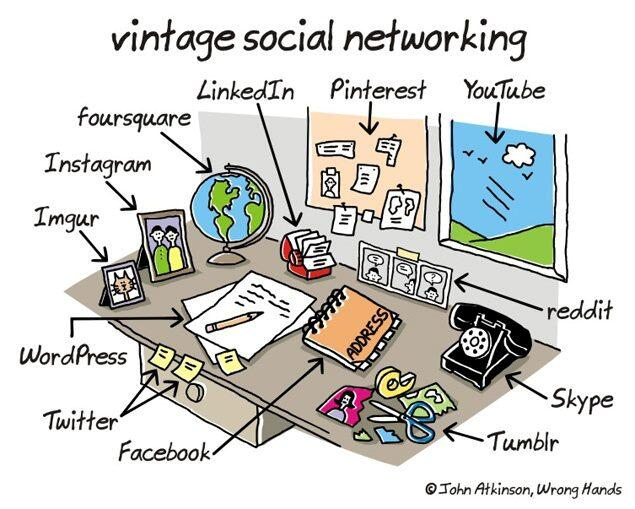
Yes, the white square symbol might not have gained traction so quickly had it not been for Twat and Book, and would we have known about globally white-squared posters so rapidly had it not been for Instagram and Pinterest (not that Instagram and Pinterest are social media per se – think of them as a more interactive version of holiday snaps, football card swaps, or stamp collections)? Had it not been for YouTube, would we have seen the ickle film featuring that man who looks a lot like an old Tilda Swinton?

I take all of this on board. Yes, I get it. But I come from a time BSM (before social media) and while it might have taken a bit more effort, all of it could have been achieved without social (and without a frankly pointless app that allows you to post a white square over your own face.) (/headinhands/ Over your own face. /headinhands/)

There was a time when the Tilda Bowie movie would have been shown on TV, and you’d have had to wait up all night for it. A time when you’d have simply woken up to find white squares over everything (as a result of global overnight fly-posting).

A time when all would have been revealed with massive simultaneous launch events on however many continents there are these days. It would have taken real effort – on the part of both promoter and fan – and would have been that much better for it. (Obviously,  Iman would still have given interviews and the V&A would still be doing a retrospective.)

So step away from the credit, social media, and no-one will get hurt. And no, as someone connected with all this claimed, this does not make social a valid ‘business and sales tool’.

That Image PR-oblem – Again

It was some time ago, dearest blog trotters, that I posted this piece, which dealt with an article in ye olde Evening Staaaaaandard of foggy London Town (do the light clickdango and see for yourselves) in which – as a passing and, it has to be said, quite humorous, aside – the PR profession was lumped together with terrorism and the sex-trade as being – erm – a ‘flexible’ sector of the economy.

Anyway, as you’d expect, I go off on one about it. And yes, I’m self-aware enough to realise that – instead of wailing and roaring at the sky, rending my garments and gnashing my teeth – I should probably try and do something to rectify the situation, given that I’ve been aware of the PR image problem for almost as long as I’ve been on the game, and while I feel justified in saying that I’d like the £200 I give to the CIPR each year to be spent on mitigating against it (not too much to ask, I don’t think), I know that if you want something done properly, you’ve got to do it yourself.

Only. Just as you’re about to gird up your loins and draw your sword of PR truth and justice (are you sniggering at the PR sword, or my loins? It’s hard to tell), thinking that, maybe, just this once, this time it’ll be different, you find that not only is PR’s image problem alive and well, it seems to have taken on new depth (if I can term it thus) and, to cap it all, it’s being fluffed by the the sort of horrible PR luvvy that gave it a bad name in the first place.

What came first – the stereotype or the image problem?

Whatever – have a gander at this.

It’s the scary and salutary story of  PR people Kathryn Kirton and Jamie Kaye, who – long story short – fiddled the budget and defrauded their employer/client out of £19k and £5k respectively. How they thought they were going to get away with this, the Lord only knows. It is completely half-arsed. Had the scam had a whole arse, they – I put it to you – would have got away with a hell of a lot more. So not only stupid and dishonest, but with added stupid. Couldn’t even come up with a good scam.

Now, this would have been enough to – once again – drag the profession through the dog doo. PR people – liars and cheats and – damningly – not very good at it. But there’s more. Here’s what m’lud, Judge John Hillen, has – in his wisdom – to say about PR. Bear in mind that he had undoubtedly formed this opinion before being exposed to the twatmonsters Kirton and Kaye, as he obviously factored it in when reaching his conclusions.

“(Judge John Hillen) said the case reflected the temptations on offer in (the PR) profession.

‘In the world of PR you are surrounded by luxury items. That is reality for people working in that industry but this is not the place to explore the PR industry,’ the judge told them.”

Let’s just take a moment, shall we? I personally will use this time out to survey the luxury items that I am surrounded by and that make up the reality of working in this – what? Sorry? Oh. Yes. It’s nonsense. Absolute crap. There are no luxury items and it is not my reality.

So in this round of what came first, stereotype or image problem, I’d have to go image problem, but just by a short luxury item. I guess we could go further and ask whether the image problem attracts the wrong people, or whether the wrong people create the image problem – but frankly, life is to short.

We need to do something about it. And I guess that means me.

When Two Become One – Social Media and the Abuse of Language

Boom, snorkellers mine! Or is it ‘boosh’? Recently I had my faith in ‘boom’ as the young person’s emphatic of choice somewhat shaken when the young person I use as my ‘young person barometer’ opted for the latter. But it is possible that said young person was still coated in fall-out from the Jack Black oeuvre ‘Gulliver’s Travels’, where Mr Black does, in fact, use ‘boosh’ to denote triumph and satisfaction. Which then begs the question, did he use ‘boosh’ because he is American? Or because it was a family movie? Or both?  I will admit to worrying slightly about ‘boom’, as I suspect it has overtones of ‘gangsta’. But, and indeed, hey – that’s the way I roll.

Which digression leads us nicely into the theme of today’s meander down language lane. Oh yes, syntaxmen, grammarians and semanticleers, another excursion into the verbiage. So, those of you who’ve been here before (wind whistles round an empty, cavernous space and a small, adolescent tumbleweed rolls gently into the dusty distance) will know that one of my greatest bugbears is the abuse of language – whether that’s language used wrongly, or words that are made up, slapdash errors or mistakes that have become so commonplace that they are now practically accepted as part of the language they undermine. I refer, of course, to apostrophe’s.

The other thing that makes me seethe, of course, is social media. Now – and before anyone starts – I am not a social media denier. How can anyone be a social media denier? I am someone who does not believe that social media is the be-all and end-all. I see no reason for there to be a social media industry. I have no time for social media gurus. I do not believe that social media add any real value whatsoever, and I remain convinced that they are practically useless in any sort of commercial (sales and marketing) environment. At best another set of media for communications purposes, at worst, dangerous, misguided and damaging (for a brand or organisation, anyway). Shallow, one-dimensional and self-obsessed – that’s social.

So imagine my joy when I came across this: “We have learned through experience tweeple don’t like brands jumping in if they have chosen not to include them. It could cause a black lash especially if they are out spoken. It is strange but they don’t like being watched even though
it’s public forum.

Do the users of Twitter know they’re being called ‘tweeple’? Do they call themselves ‘tweeple’? Are the Tweeple the inhabitants of Tweetville? If there are many Tweeple, are there individual Twersons? Does anyone have any idea how much this makes social media seem like a figment of the imagination of Dr Seuss and one that makes even less sense than a portion of green eggs and ham? What, social medians, are you thinking of?

I am a guardian of corporate reputation by profession. Something I’ve learnt is that, if you want to be taken seriously, you don’t give yourself a ridiculous name. It takes a long time and a lot of effort before you can start being jokey with your brand, and even then, the jokes have got to be clever and make people think. Or, of course, you can start out with a ‘whacky’ personality (Innocent Drinks) but even then it needs to be thought through to the nth degree. In this case, you’ve got a case of the whackies without any longevity or substance. And it is value and reputation-destructive.

But, hey (again), go with the flow. In the spirit of entente cordiale, here are a few generic nouns I’ve come up with for the users of other social media. These are free and anyone can use them without even thanking me. (Although it would be nice, obviously.)

Faceboks. Tumbleers. Foursquats. Instagrates. Youtubigrips. Pinteresticles.

And, of course, it’s not Tweeple.

It’s Twats.

Social Media – a Two Trick Pony

Let’s look at what’s new for 2013 – don’t think it’s too late – erm…riffling through the deck…ooooh, here’s one! Pheed! And Thumb, and Chirpify! And Flayvr and Medium (the cerebral platform, apparently.)

Nope, me neither. New toys, but nothing that promises a) more than we had before or b) any sort of progress against the Holy Grail de nos jours – that of delivering an actual, measurable, commercial result from social media.

When (oh when, oh when) are we (as communicators) going to admit that when we discuss social media as tools, we’re actually talking two things – Facebook and Twitter. Incidentally why is it two  and not one? By which I mean why hasn’t Zuckerberg’s Sylvester eaten Tweety pie, or at least, seen it wither and die?

Because one is big and the other is small – in terms of what you can post, what you can share and the general longevity of your self-absorption – and they do not threaten each other. (Mind, Twitter decided you could post six second long video clips and within a day at least one someone had posted freely viewable porn. Says it all.)

They occupy the two big social media spaces (compiling a public library of your all? and washing your ego in public), and there is no room for anything else. Whisper it, but social media are shallow and one-dimensional.

‘Course, what this means is that Twitter is good for informational updates and Facebook is like war. (Hurgh!) (Sorry, obvious gag, saw the opportunity, couldn’t resist, etc.) Facebook is ‘good’ for – well – at least monitoring the ravings of the internet, occasionally for some developmental feedback for your brand, as a repository of content that someone might, one day, use, and as an unexpungeable record of your brand’s mistakes.

Now I hear the susurration of dissent from Outraged of Old Street and Hoxton, and I proffer mitigation. As part of a fully integrated campaign, both ‘Book and Twit have roles to play – further promoting your message and, yes, encouraging ‘conversation’ (the very word, in this context, makes me shudder).

Particularly splendid is social media integration into experiential marketing around one-off special events (the telcos do it well, but, as they put social-on-the-go into your hands in the first place, you’d be astounded if they didn’t) but let’s not kid ourselves, Fb and Tw (two new elements – one heavy and lumpen-of-share-price, the other fizzing around and exploding into nothing) are add-ons. Not standalones.

There is no measureable correlation between sales and SM activity and, arguably, none between corporate reputation building and solus SM activity. Even Blackberry (aren’t you glad they ditched ‘RIM’?), who are good at this stuff and believe in it, are spending shootloads on Neil Gaiman, Alicia Keys and the Mercedes F1 team to add substance to their social.

There is, of course, a fairly high correlation between corporate reputation destruction and SM generally – because social media (and digital media, to make the distinction between blogs and specialist websites and Facebook and Twitter) provide even the most frightening of gnolls, in their darkened bedrooms on the outskirts of Grimsby, with a voice and the immediate, uncontrolled opportunity to air it. They can say what they like – valid or invalid, polite or impolite – and there’s no telling what will set them off. Internet Tourette’s.

All that being as it may, if there are only two social media (*), surely we have to question the entire existence of ‘social media guru’. Rather than claim overview expertise in a field that is actually rather more of a small backyard (for the purposes of communications and marketing) would we not be better (and I know it goes against the grain, or maybe it’s fashionable again?) specialising in particular aspects of SM?

There’d be a new breed of social media consultants called ‘Faceboks’ – a name which conjures images of wild creatures, fleet-of-foot and raising-of-bar, easily outrunning the grizzled, baggy predators of old media.

Clearly, no-one would want to specialise in Twitter.

(*) LinkedIn is not a social medium. Would you show an employer pictures of you drinking tequila naked with a goat called Tufty? No.

That Old Content Myth

So. I’ve been reading a book with the rather pointed title of ‘Social Media is Bullshit’, by one BJ Mendelson. Available from Amazon, it is (sound a bit like Yoda, there – ‘when 900 years old you reach, look as good you will not’ – and I’m fairly certain this post will not change the opinon of that great morass of people who think I’m a dinosaur), at a fairly impressive price, even for the Kindle edition, of over eight of your finest sovereigns. As, as someone pointed out to me, you don’t actually get anything papery for that, neither.

That being as it may, as it usually is, I was delighted to find that someone had written a book agreeing with my entire premise on the subject of social, and that, therefore, if there are two of us, there must be more. Not alone. Like the caveman crawling out of the dark and gazing up at the stars – ‘I’m not alone’. (Obviously, that was his second thought, coming shortly after ‘Oh f*ck me, would you ever look at that.’)

Anyway, the premise of the book is that social media are just more media. Nothing special about them, nothing magical and certainly nothing life-changing. With social media, as with so much else, your success will be dictated by luck, how well-known you were beforehand, whether you’re famous already and how much money you’re prepared to spank away on other types of communication (this is important chaps) to bolster your social. But mostly it’s luck.

All this horsedoo about content and community and conversation is exactly that – just horsedoo. Ideas propagated by the only people who will ever ‘monetise’ social media – yep, the snake-oil-selling social media gurus, the ones who make their money out of telling you how to make social work for you. (And the answer still remains – ‘it doesn’t’.)

All of this put me in mind of something I wrote a while back – actually a comment on another blog. It was about just that idea that somehow social media ‘content’ is a mystical, magical substance that doesn’t have to obey the same rules as traditional ‘stuff’ – by which I mean be interesting, compelling, unique or new. All things that news used to be before it – oh, hold on, news still is, isn’t it? It’s the main currency of broadcast and print media – still very much alive, still terribly well, thanks, and communicating effectively with an enormous audience near you right now.

Here you are (nothing like promoting my own thoughts):

“It’s still about news. News is content, content is news. No-one is (in the main) interested in something that’s not new to them. The old adage about the things that make news – sex, celebrity, money, technology, controversy and ‘fluffy bunnies’ – still holds true.

The press release was always treated like spam, even in the days when they were delivered in cleft sticks by men in loincloths. Why? Because news releases were, are and always will be – in the main – badly targeted and of little relevance to the person receiving them.

The CEO of Joe Bloggs, the clothing company, was known as Chef Underpant Officer – probably apocryphal, although I’d love it to be true. No matter, the point is that it’s not importnt what you’re called, if you’re in communications, your job is to create presence for your clients and their messages.

Which is why all this conversation, community, content nonsense is exactly that – nonsense. We’re not in the game of creating communities, or conversation, on the offchance that someone might wish to participate, not more are we in the game of creating lovely free content that someone might wish to view.

We – as communicators – are in the business of selling. Which is why social media don’t really work as commercial marketing or comms tools.”

Boom!

Social Media – Waiting for the Wheels to Fall Off

I say, I say, I say. What do you call 600,000 people leaving Facebook? I’m afraid I do not know what I would call 600,000 people leaving Facebook – do please enlighten me. You would call it – a start! (Ba-dum tish. Thank you, thank you, I’ll be here all week, next show starts at eight-thirty, do try the veal etc etc etc.)

So that’s the news today, blog trotters mine, off of the back of Instagram (something that allows you to share photos apparently – although why you would want to share photos with anyone save close friends and family, unless you wuz an exhibitionist – hold on, you’re not an exhibitionist are you?) losing vast swathes of its user base because it was going to sell people’s pictures to advertisers. (Thank you, Metro.)

Two things, people. If you stick your photos up on t’interworldyweb, then someone is going to use them. Get over it, stupid. If you give away your privacy, you won’t have it any more. Derrrr. Then, Mr Instagram (or can I call you Brian?), as I’ve said before, in the socially mediaevil world that we live in, if you try and blatantly monetise the onlinesters, they will disappear without a trace. AND THEY WILL NOT COME BACK. And neither will anyone else. Call yourself a guru, Brian? You’re just another soft-centred hippy getting the whole ‘business’ thing badly wrong.

Meanwhile, although it’s too soon to say (I know) – but when has that ever stopped me – the feeling has to be that Facebook is falling into the same trap (albeit in a different way). The thing about Facebook, as I understood it, was that it was a free-for-all, free-to-air community, happily unregulated, where people could live and share and communicate (and, obviously, be trolls and dump their garbage and bully and groom and all the other exciting stuff that people get up to in their darkened rooms on the outskirts of Grimsby).

Now we find that His Odiousness, the Markster, is about to zuck you all, once again, with a something. Not sure whether it’s a device, or a piece of software. but, guaranteed, he’s going to be monetising you. He’s coming for your cash. Because that’s the only way he can prop up his hideously over-valued and over-inflated empire.

And if I’ve said it once, I’ve said it – oooooh – a handful of times, if you get all blatantly commercial on your social media bunnies, they scamper off into the undergrowth. Which is why, dear blogsters, the news that the ‘book is building something, and wants the media to come and see what it is, and the subsequent speculation that it’s a ‘phone, or a search engine, has led to a bit of a dead-hippy bounce in the share price (because maybe the something will be revenue-generating) and an exodus of some 600,000 facebook users.

As the yout’ of today would have it – ‘boom’.

Social Media Are Now Addictive – Official

I’d often wondered what they were cutting that Facebook with. All that inanity, and insanity, and lack of self-control and propensity for sometimes career-threatening embarrasment, and morals out the window and sheer filth – it’s all so clear now.

The inability to walk away from it, to leave it alone – an itch that has to be scratched, a digital open wound – the tippity-tappety of fingers on device, from morning ’til night – why couldn’t we see it? The Evil Boy Turd, Zuckerberg, is obviously lacing his product with something with the dependency-generating qualities of crack, or scag, or meth and the mind-to-cheese-turning properties of e or mephedrone.

Rather like the creepy bloke hanging around outside the campus gates, handing out sweeties for free, and promising to hand out more on demand. Which then turn out to cost something.

What’s that? Sorry? Oh. You mean you can’t adulterate a website with an addictive substance? So what’s going on then?

Oh.

So you’re saying that the compulsion to get on to Facebook or Twitter or MyTumblinstagram at every opportunity, the inability to carry out seemingly simple tasks without checking your alerts, is – in fact – just the failure of those with weak wills or limited self-control to get a grip?

And, further, that the flood of rubbish content found on social media is not the result of substance raddled minds, but simply of the fact that the vast majority of people using these media are self-obsessed, sub-standard mutants with barely an original thought to share between them?

In summary then, this new ‘addiction’ is not really an addiction at all. It’s an excuse for people not to put their devices down. It’s an excuse for them to behave badly and justify their rudeness? It creates a new industry – people who treat social media addictions – and it breathes the oxygen of publicity (once again) into something that is purposeless and (so far) valueless?

Ah.

So this article (from the Evening Standard) is hardly worth reading.

The Social Media Marketing Miracle That Wasn’t

What a fantastic title this post has (even if I do say so myself), and all the better for having been delivered to me, on a plate, courtesy of The New York Times in this genuinely thought-provoking piece about the inherent value of social media and how it is linked to the socio-cultural phenomenon behind them and their growth. (Ooooh, get me and my socio-cultural phenomena!) (Yes, yes. Alright. I made it up. No, I don’t know what it means.)

Anyhoo, the key point (for me) is this:

“That, in fact, may be the ultimate lesson to draw from the social media marketing miracle that wasn’t. The impact of new technologies is invariably misjudged because we measure the future with yardsticks from the past.”

Now, being breathtakingly simplistic here, what this can be taken to mean is that social media are being judged (in a commercial sense) by their usefulness as marketing or communications tools – because there must be a way to monetise them. Worse, those who do not see them in this light, or judge them using these yardsticks, are seen as naysayers and luddites.

Obviously, this is wrong. Social media are not sales, marketing or communications tools in a commercial sense. This is not awkwardness, or a refusal to go into the light – this is trying to see beyond the traditional uses of ‘media’, by which all such channels are judged (at present).

I’m with the author of this article (well done, sir!) when he says:

“Social networks, like them or not, are fast laying out a new grid of personal connections. Even if this matrix of humanity sputters in advertising and marketing, it’s bound to spawn new industries in consulting, education, collaborative design, market research, media and loads of products and services yet to be imagined. Maybe, just maybe, it will even be able to sell soap.”

Not sure about the soap, mind.